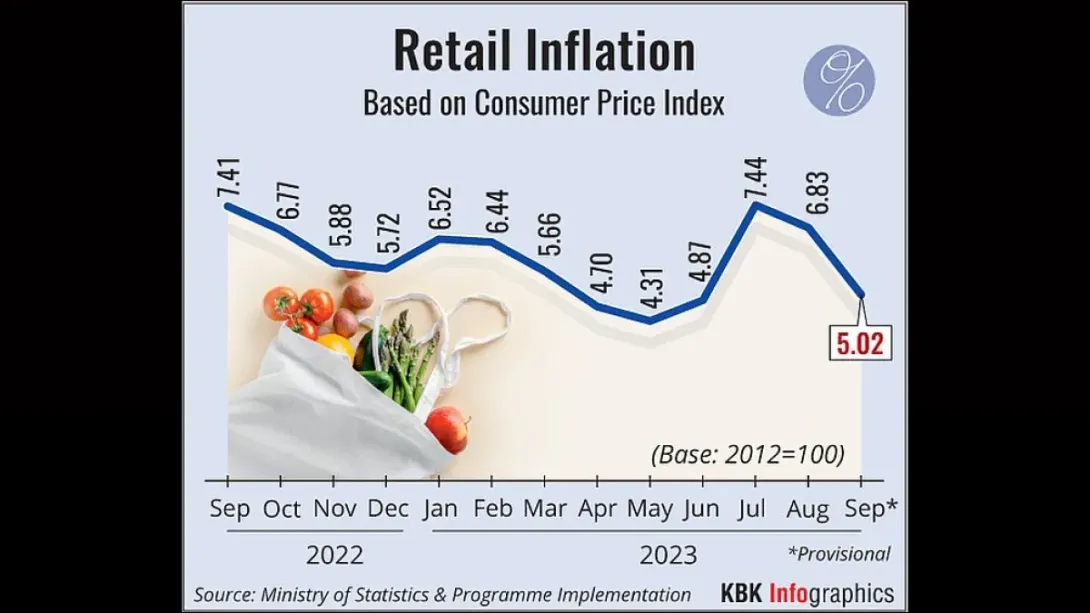
India witnessed a marginal decline in retail inflation for both agricultural and rural laborers in September, offering respite to low-income households grappling with persistent price pressures. According to the latest data from the Labour Bureau, inflation measured by the Consumer Price Index for Agricultural Labourers (CPI-AL) and Rural Labourers (CPI-RL) eased slightly as food prices moderated across several key categories. The decline, though modest, reflects improving supply conditions and effective government interventions in essential commodities. Economists suggest that this cooling trend could support rural consumption ahead of the festive season, providing a cautiously optimistic signal for India’s broader inflation trajectory.
Inflation Trends Indicate Gradual Relief
Retail inflation for agricultural laborers declined to 7.13% in September from 7.34% in August, while for rural laborers, it fell to 7.05% from 7.26% during the same period, according to official data released by the Labour Bureau under the Ministry of Labour and Employment.
The easing was primarily driven by softer prices in food items such as cereals, pulses, and vegetables — key components of rural consumption baskets. Non-food categories, including fuel and clothing, saw moderate price increases but remained within manageable levels.
Although inflation continues to hover above the Reserve Bank of India’s medium-term target of 4%, the downtrend offers some comfort, especially after months of elevated food inflation triggered by erratic monsoon patterns and supply disruptions.
Food Price Moderation: The Key Driver
Food inflation remains the most critical factor influencing price levels for India’s rural and farm workers. The September data revealed that price increases for staple items such as rice, pulses, and edible oils slowed compared to August, thanks to improved supply chains and government efforts to stabilize prices through open market interventions.
Vegetable prices, which surged sharply during the monsoon months, also showed signs of normalization. Onion and tomato prices — notorious for their volatility — began to decline following the arrival of fresh harvests in key producing states.
Economists note that while the easing of food prices has helped moderate inflation, continued vigilance is necessary as weather conditions and global commodity trends remain uncertain.
State-Wise Trends Show Mixed Performance
The Labour Bureau’s report highlighted regional variations in inflation rates, with certain states witnessing sharper moderation than others. Tamil Nadu and Karnataka recorded noticeable declines in food inflation due to strong agricultural output and stable market supplies.
In contrast, states like West Bengal and Assam continued to experience higher inflation, largely due to localized disruptions and higher transport costs. The differential reflects the complex nature of India’s rural economy, where supply chain efficiencies and climatic conditions vary significantly from region to region.
Such disparities underline the need for targeted policy interventions to address state-specific challenges, particularly in states that are more vulnerable to weather shocks and price volatility.
Policy Context and Economic Implications
The easing of rural inflation comes at a critical juncture as the Reserve Bank of India maintains a cautious stance on monetary policy. The central bank has kept policy rates steady for several months, focusing on anchoring inflation expectations while supporting economic growth.
A sustained decline in rural inflation could provide policymakers with greater flexibility in the coming quarters, especially if the trend extends into the post-harvest period. Lower inflation also enhances rural purchasing power — a crucial factor in driving consumption, which accounts for nearly 60% of India’s GDP.
Furthermore, the moderation in price pressures aligns with the government’s broader objectives of ensuring food security, stabilizing input costs, and strengthening rural livelihoods through schemes like the Public Distribution System (PDS) and PM-KISAN.
Outlook: Cautious Optimism Ahead
While September’s inflation data offers a welcome reprieve, experts caution that the outlook remains contingent on multiple factors — including the upcoming rabi sowing season, global commodity prices, and geopolitical tensions that could affect import costs.
If favorable weather persists and agricultural output remains strong, rural inflation could continue to ease, supporting both household consumption and macroeconomic stability. However, any disruption in food supply chains or unexpected spikes in crude oil prices could reverse recent gains.
In the near term, policymakers and analysts alike will closely monitor rural price trends as they serve as a bellwether for overall inflation dynamics. For now, the easing of inflation among farm and rural workers offers a glimmer of relief — and a timely boost to rural sentiment as the festive season approaches.
Comments