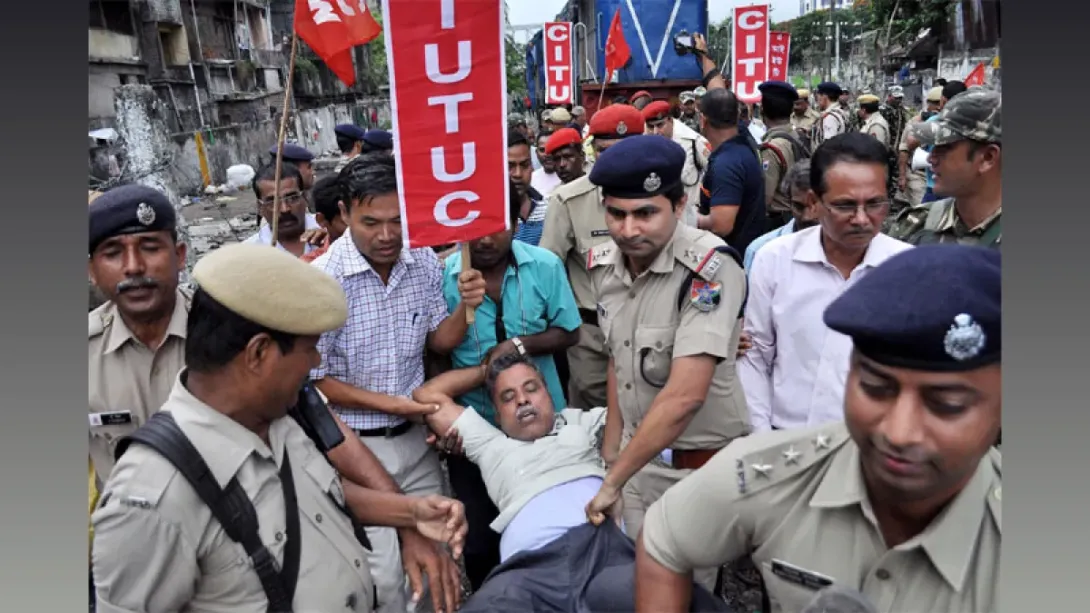
Transport unions across Maharashtra have declared an indefinite statewide strike beginning March 5, escalating tensions between operators and the state government over electronic traffic fines and regulatory grievances. The Maharashtra Transporters Action Committee, representing truckers, private bus operators and taxi unions, said recent discussions with authorities failed to yield concrete assurances. If implemented, the strike could disrupt freight movement, school transport and urban mobility across key economic corridors. The state government has urged unions to reconsider, signaling willingness to review disputed e-challans. The confrontation underscores mounting friction between compliance enforcement and operational sustainability in India’s transport economy.
Strike Call Signals Broad-Based Mobilization
The Maharashtra Transporters Action Committee has reaffirmed its decision to launch an indefinite agitation from March 5, intensifying a dispute centered on electronic traffic enforcement and broader operational concerns.
The coalition represents a wide cross-section of the transport ecosystem, including truck operators, private and contract bus services, tanker operators, taxi associations and autorickshaw unions. Leaders indicated that commercial vehicles — ranging from freight trucks and tempos to school buses and passenger taxis — would remain off the roads during the protest.
Given Maharashtra’s role as one of India’s most industrialized states, any prolonged disruption could materially affect supply chains, retail distribution and commuter mobility.
Talks With Government Yield Limited Progress
Union representatives met state officials in Mumbai in a bid to resolve the impasse. The meeting was convened by Pratap Sarnaik at the headquarters of the Maharashtra State Road Transport Corporation.
Senior administrative and police officials, including Transport Commissioner Rajesh Narvekar, were present during the discussions.
Following the meeting, union leaders stated that they had not received binding commitments addressing their core demands. In particular, transporters expressed dissatisfaction over what they characterized as arbitrary or unjust e-challans issued to vehicles, including those allegedly fined while parked.
In an official statement, the minister appealed for restraint and requested that unions withdraw their agitation. He indicated that the government was open to reviewing disputed fines and was positively inclined toward cancelling penalties deemed unfair.
The E-Challan Flashpoint
Electronic traffic enforcement systems were introduced to enhance compliance, transparency and accountability in road transport regulation. However, transporters argue that automated enforcement mechanisms sometimes generate erroneous penalties, creating financial strain and administrative burden.
Operators contend that the cumulative impact of such fines — particularly when levied on commercial fleets — erodes already thin margins in a sector grappling with fuel price volatility, toll charges and financing costs.
From a policy standpoint, the state’s enforcement push aligns with national digitization initiatives. Yet the dispute highlights a recurring governance challenge: technological modernization must be accompanied by robust grievance redressal mechanisms to preserve stakeholder trust.
Economic Implications for Maharashtra
Maharashtra serves as a critical logistics hub, with Mumbai functioning as a financial nucleus and gateway port city. A sustained transport shutdown could disrupt goods movement across industrial belts, delay deliveries in urban centers and interrupt school and employee commutes.
Freight-dependent sectors such as agriculture, manufacturing and retail may face bottlenecks if tanker and truck operations are suspended. In metropolitan regions, taxi and bus disruptions could further strain public mobility networks.
While short-term strikes often exert pressure without long-term damage, an indefinite agitation carries broader macroeconomic risks if negotiations stall.
A Test of Negotiation and Governance
The unfolding confrontation reflects a larger structural tension between regulatory enforcement and industry viability. Governments seek stricter compliance to improve road safety and administrative efficiency. Transport operators, meanwhile, demand procedural fairness and economic sustainability.
Resolution will likely hinge on whether authorities can provide transparent review processes for disputed fines and institutional assurances against arbitrary enforcement. Conversely, unions must weigh the economic costs of prolonged disruption against the strategic leverage of collective action.
The Road Ahead
As March 5 approaches, Maharashtra stands at a crossroads between confrontation and compromise. Both sides have signaled openness to dialogue, yet trust deficits remain.
For policymakers, the episode serves as a reminder that digitization without accountability can provoke resistance. For transporters, it underscores the need for structured engagement within regulatory frameworks.
Whether the strike proceeds or is averted through last-minute negotiations, the outcome will shape the relationship between the state and one of its most economically consequential sectors.
Comments