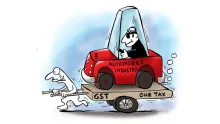
GST

By Gurjot Singh , 16 September 2025

The recent reduction in Goods and Services Tax (GST) rates on automobiles has inadvertently created disruptions in the auto financing market, with several customers cancelling their existing car loans to take advantage of lower vehicle prices. Lenders, dealers, and automakers are grappling with the unexpected fallout as buyers reconsider loan agreements signed prior to the tax revision.

By Tushar Sharma , 14 September 2025

TVS Motor Company is poised to benefit from the recent cut in Goods and Services Tax (GST) rates on two-wheelers, with analysts expecting a surge in consumer demand. The tax reduction is likely to improve affordability, especially in price-sensitive segments, and stimulate rural and urban sales alike. Industry experts believe that the move could revive growth momentum in India’s two-wheeler market, which had been subdued by high fuel prices and inflationary pressures.

By Binnypriya Singh , 14 September 2025

Senior parliamentarian Shashi Tharoor has emphasized the potential of Goods and Services Tax (GST) rate reductions to stimulate India’s economy. By advocating for calibrated cuts, he underscored the importance of easing the burden on businesses and consumers while broadening the tax base. Tharoor argued that lower rates could invigorate demand, support small enterprises, and make compliance more attractive, ultimately strengthening revenue collection.

By Tushar Sharma , 13 September 2025

The Indian government has slashed the Goods and Services Tax (GST) on motorcycles and scooters with engine capacities up to 350cc from 28% to 18%, effective September 22, 2025. This move is expected to lower vehicle prices significantly, making two-wheelers more affordable for middle-class consumers and stimulating demand in the automotive sector. Leading manufacturers such as Honda, Hero MotoCorp, and Yamaha have announced price reductions of up to ₹18,887 on select models. The measure also aims to boost sales ahead of the festive season while supporting broader economic growth.

By Tushar Sharma , 11 September 2025

Hyundai has taken another decisive step in the electric mobility race with the unveiling of its latest prototype, the Concept Three, a compact electric car designed for city commuting. The model emphasizes sustainability, affordability, and cutting-edge technology, underscoring the automaker’s strategy to capture a wider consumer base in the growing electric vehicle (EV) segment.

By Gurjot Singh , 11 September 2025

The Goods and Services Tax (GST) regime continues to weigh heavily on the Indian two-wheeler industry, with motorcycles and scooters falling under the highest GST slab of 28%. Industry representatives argue that treating essential mobility vehicles on par with luxury goods undermines affordability for millions of consumers, particularly in rural and semi-urban areas where motorcycles remain a lifeline. Rising fuel prices and inflation have already dampened sales, and the additional tax burden has further constrained recovery.

By Eknath Deshpande , 10 September 2025

The imposition of Goods and Services Tax (GST) on health insurance premiums has emerged as a pressing concern for both policyholders and industry stakeholders. With premiums already rising due to medical inflation and higher claim ratios, the additional 18% GST has further strained affordability for individuals and families. While the government views GST collections as a critical revenue stream, critics argue that taxing health protection discourages insurance penetration in a country where coverage remains relatively low.

By Gurjot Singh , 9 September 2025

Food delivery in India is poised for a notable price increase as rising operational expenses, inflationary pressures, and growing labor and fuel costs weigh on delivery platforms. Companies such as Swiggy, Zomato, and other aggregators are expected to pass a portion of these expenses onto consumers, affecting order pricing and delivery charges. Analysts note that while demand for online food delivery remains robust, prolonged cost pressures could influence customer behavior, spurring shifts toward value-conscious ordering and alternative dining options.

By Eknath Deshpande , 9 September 2025

Skoda India is offering significant price reductions on its key models following the recent Goods and Services Tax (GST) cut, providing customers with savings of up to Rs. 5.8 lakh. The benefits apply across popular models including the Kushaq, Slavia, and Kodiaq, enhancing affordability and potentially boosting demand in both compact and premium segments. Coupled with additional manufacturer incentives and financing schemes, these reductions make Skoda’s offerings more competitive against rivals.

By Gurjot Singh , 9 September 2025

The Indian automotive sector is witnessing immediate consumer benefits following the government’s recent Goods and Services Tax (GST) reduction. Automakers including Maruti Suzuki, Hyundai, Mahindra, Tata Motors, Toyota, Skoda, Renault, BMW, and Mercedes have revised their pricing structures, passing on the tax relief to buyers. The move is expected to stimulate demand in a segment that has faced pressure from rising input costs and slowing sales.